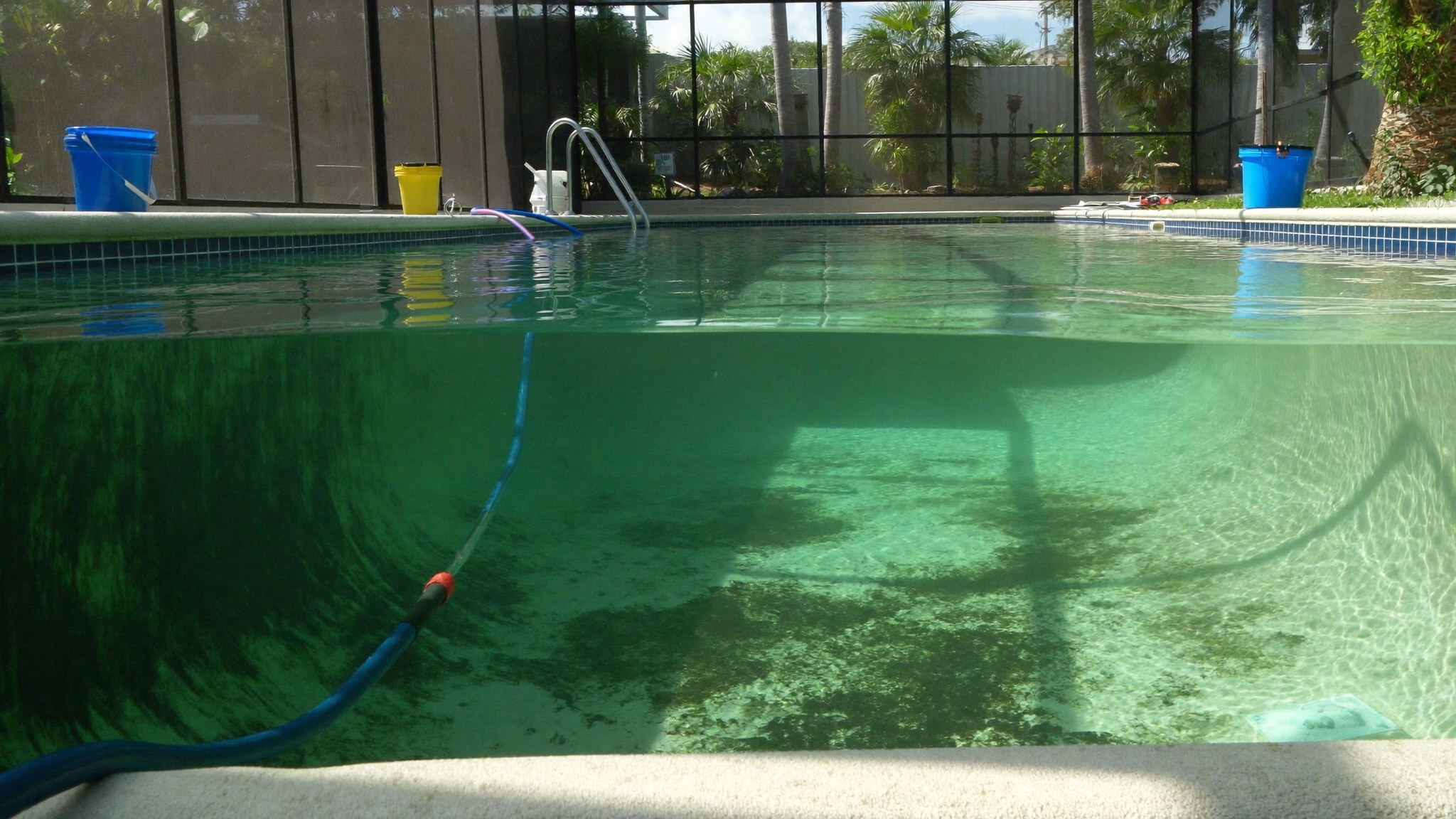
Every summer we get the same call: "We got back from two weeks away and the pool is a pond." The good news is that a green pool is almost never a disaster — it's chemistry plus filtration plus patience, in that order. Here's exactly how we run a rescue.
First: don't drain it
Draining feels intuitive and is usually the worst move. In our soil, an empty shell can shift or float when the water table is up, and fresh fill water needs a full chemistry build from zero anyway. Unless the water is chemically ruined — years of neglect, extreme stabilizer lock — we rescue the water you have.
Day 1: assess, clear, shock
We test everything — chlorine, pH, alkalinity, stabilizer, phosphates — and net out leaves and debris so the chemicals work on algae, not oak litter. Then the pool gets a heavy shock dosed to its actual volume and condition, with pH pulled low-normal first so the chlorine actually bites. The pump runs 24 hours a day from here on.
Days 2–3: the filter does the heavy lifting
Dead algae turns the water from green to cloudy gray — a good sign. Now it's a filtration race: we brush walls and floor daily to keep algae suspended, vacuum out what settles, and clean the filter every day. A rescue can clog a cartridge in hours; a filter left dirty stalls the whole recovery. This is where most DIY attempts die.
Day 4: balance and hand-off
Once the water polishes up, we rebalance for swimming — chlorine back to normal range, pH and alkalinity corrected, stabilizer checked so the sun doesn't burn off your chlorine by noon. You get a simple plan to keep it clear, and if you want us to handle it weekly, that's available but never required.
Light bloom: 48 hours. Solid green: 3–5 days. Black-green swamp with a dirty filter: up to a week. Anyone promising overnight results for a true swamp is either draining your pool or overselling.
Pool gone green? Text us a photo and we'll tell you what it needs — and what it'll cost — before we ever roll a truck. How Green Pool Rescue works →